
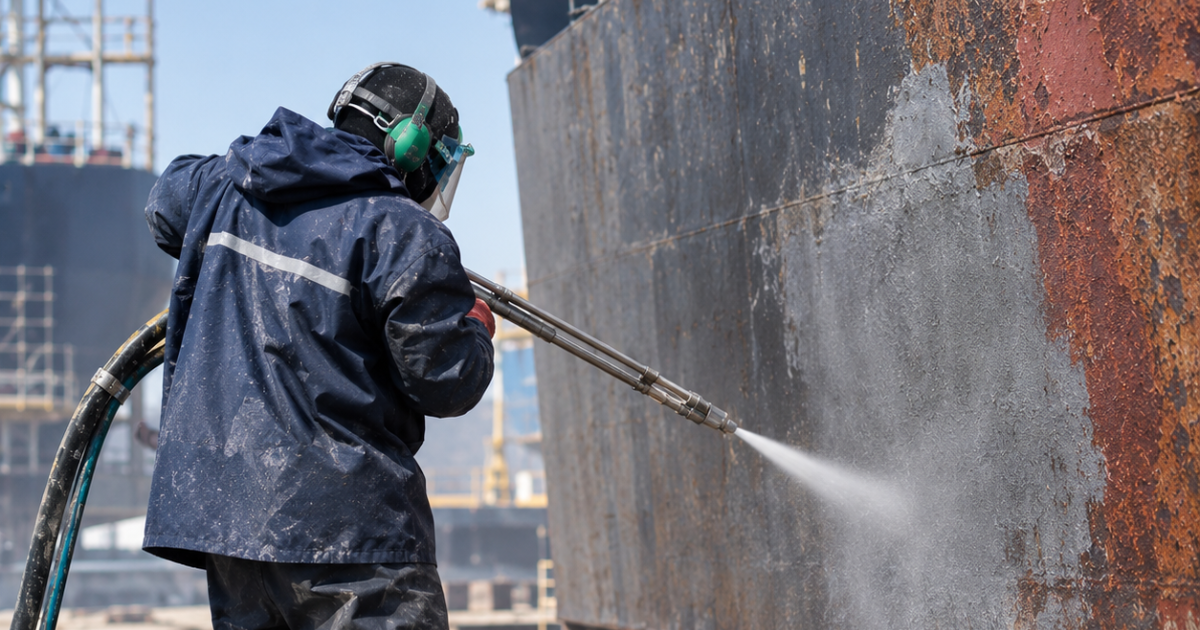
In industrial cleaning, choosing the right method isn’t always obvious. Hydro blasting is the most widespread technique, but there are cases where using an abrasive medium combined with water delivers results that plain water pressure alone cannot achieve.
Water sandblasting is exactly that solution: a technique that combines the force of water with the action of an abrasive material, to treat surfaces that require deeper processing.
What Water Sandblasting Is
Water sandblasting is a cleaning method that uses a mixture of water and abrasive material (usually sand), propelled under pressure through compressed air.
The result is a surface with excellent roughness, suitable for immediate painting or coating. Unlike dry sandblasting, water sandblasting significantly reduces dust and the risk of particle dispersion into the work environment.
Where Water Sandblasting Is Applied
The method is mainly used on:
Metal surfaces of ships and hulls
Industrial structures and metal components
Equipment with rust, paint, or resins that must be fully removed
Surfaces intended for recoating or protective painting
STEPE has carried out water sandblasting projects on both ships and industrial facilities, with specialized personnel and modern equipment.
Water Sandblasting vs. Classic Hydro Blasting: What Makes the Difference
Classic hydro blasting uses exclusively high-pressure water to remove contaminants. It’s ideal for cleaning surfaces of deposits, grease, and loose material. However, there are conditions where water pressure alone is not enough:
when rust has penetrated deep into the metal
when there are old, hardened paints or resins
when a specific surface roughness is required for new paint adhesion
when the result must meet specific surface preparation standards
In these cases, water sandblasting delivers results that hydro blasting alone cannot guarantee.
Advantages of Water Sandblasting
Using water sandblasting offers significant benefits:
✔ Deep cleaning of metal surfaces
The abrasive material enhances the action of the water, allowing the removal of even the most stubborn contaminants.
✔ Reduced dust compared to dry sandblasting
The presence of water binds the particles, reducing personnel exposure and the risk of contaminating the surrounding area.
✔ Ideal preparation for painting and coating
The resulting roughness ensures better adhesion of coating materials, extending the paint’s service life.
✔ Suitable for demanding industrial and maritime environments
The method’s flexibility makes it applicable across a wide range of working conditions, from shipyards to industrial facilities.
When to Choose Water Sandblasting Instead of Hydro Blasting
The choice between hydro blasting and water sandblasting depends on the needs of each project. Water sandblasting is the right choice when:
the surface has heavy oxidation or old paint that water alone cannot remove
the client requires a specific cleanliness level (e.g. Sa 2.5 or Sa 3)
the surface is to receive anti-corrosive or marine paint
simultaneous cleaning and roughness profiling are required
STEPE’s Experience in Water Sandblasting
STEPE is active in water sandblasting with experienced personnel and equipment suited to demanding industrial and maritime environments. It has carried out projects on ships, industrial facilities, and structures where plain water pressure was not enough — achieving the level of cleanliness required by each subsequent application.