
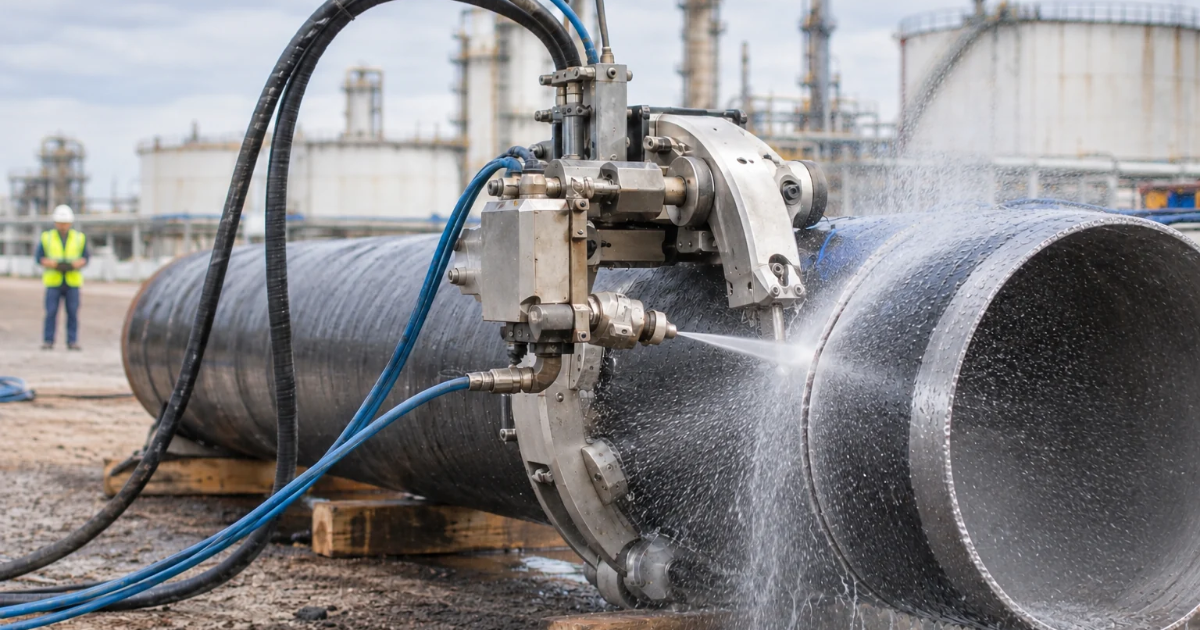
In a refinery or a fuel storage facility, even a single spark from a cutting tool can pose a hazard. Yet when a pipeline or a structure has to be cut, a method that combines precision and safety is needed. Hydrocutting is exactly that solution.
How Hydrocutting Works
Hydrocutting (Waterjet Cutting) cuts materials using ultra-high-pressure water. The water is ejected as a fine jet with a diameter of 0.55–1.4 mm, at a pressure of approximately 4,000 atmospheres, with or without the addition of an abrasive material (emery). The small diameter of the jet ensures high precision, while the work is carried out remotely, using a dedicated remote control, by a specialized technician.
Why It Is “Cold Cutting”
The method produces no heat, which makes it suitable for demanding environments:
it causes no thermal stress to the material being cut
it can be applied in areas with high concentrations of explosive gases, such as refineries, fuel pipelines, and liquid fuel storage facilities
it is environmentally friendly and poses no risk of pollution
Which Materials Can Be Cut
steel and cast iron
concrete
refractory and ceramic materials
copper and cobalt alloys
Where It Is Used
Hydrocutting is suitable for refineries, fuel pipelines, and liquid fuel storage facilities, that is, areas where heat is not permitted. The work is carried out remotely and without producing heat.
STEPE L.T.D.’s Experience in Hydrocutting
STEPE L.T.D. specializes in the hydrocutting method and has successfully undertaken the cutting of surfaces made of many different materials. With remote-controlled equipment and specialized personnel, it provides precise cutting in environments where safety is non-negotiable.