
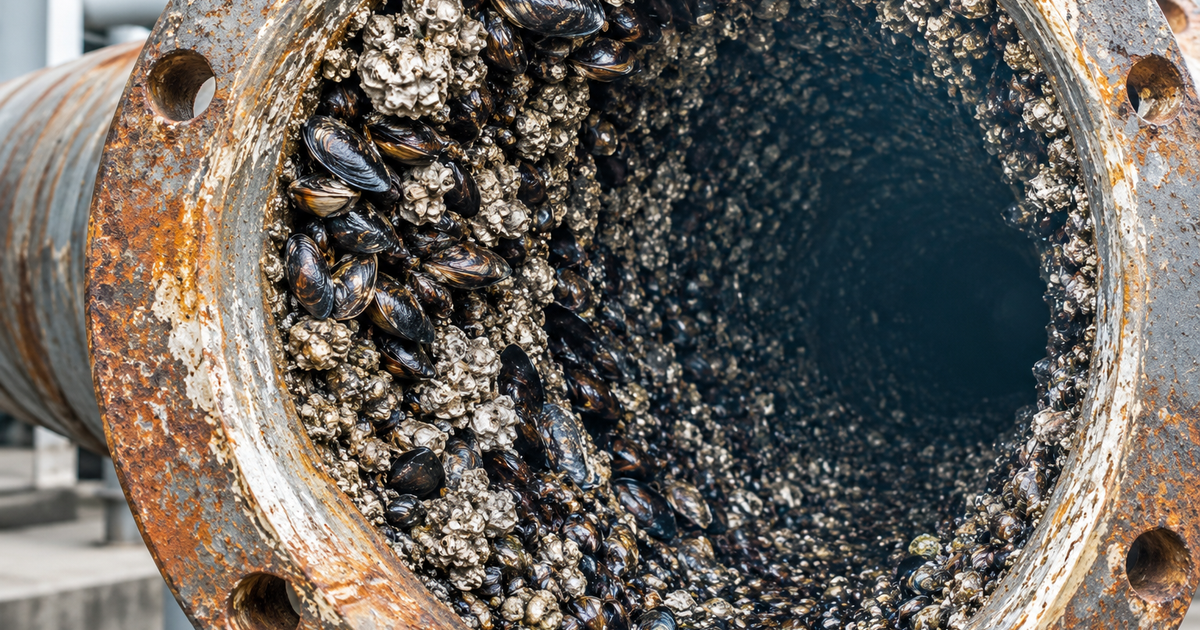
In any facility that uses seawater, the water doesn’t travel alone. Along with it come the larvae of marine organisms, which find ideal conditions inside the piping to settle and grow. The result is marine fouling (biofouling): mussels, oysters, and limpets that gradually cover the internal walls and require specialized cleaning with high-pressure hydro blasting.
How the Fouling Forms
The continuous flow of seawater supplies the organisms with oxygen and food, while the dark, sheltered walls of the pipes act as an attachment surface. Over time, the shells build up in multiple hard layers, onto which new organisms continue to attach.
The Impact on Facility Operation
Marine fouling isn’t just a cleanliness issue. It directly affects system performance:
- Reduced pipe cross-section and water flow
- Increased strain on pumps
- Reduced efficiency in cooling systems
- Accelerated corrosion beneath the fouling
- Risk of shells detaching and clogging filters and downstream equipment
How It’s Removed
The fouling is hard and firmly attached, which is why high-pressure hydro blasting is one of the most effective methods for removing it. The water jet dislodges the shells and the layers that have formed, without chemical additives. The removed material can then be collected with a vacuum system, ensuring no residue remains in the network.
The Importance of Periodic Maintenance
The longer the fouling remains, the more compact it becomes and the more demanding its removal. Scheduled cleaning limits performance losses and prevents damage to pumps and equipment.
Frequently Asked Questions
How often is cleaning needed?
It depends on water temperature, flow velocity, and the season. During the warmer months, organism growth is usually more intense. Regular inspection of the pipes is the most reliable way to schedule cleaning before system performance is affected.
Can cleaning be done without disassembly?
In many cases, yes. The work is carried out through existing access points, such as flanges or manholes. This possibility depends on the diameter, length, and configuration of each network and is assessed before work begins.
Is hydro blasting safe for the pipe?
Hydro blasting works in a purely mechanical way, without chemical additives. The pressure and nozzle type are selected based on the pipe’s material and condition, so that fouling is removed without damaging the surface.
STEPE’s Experience
STEPE has modern hydro blasting equipment reaching up to 3,000 bar and ADR-certified vacuum vehicles. It undertakes the cleaning of piping and networks in industrial and coastal facilities, restoring system flow and performance with safety for both personnel and equipment.