
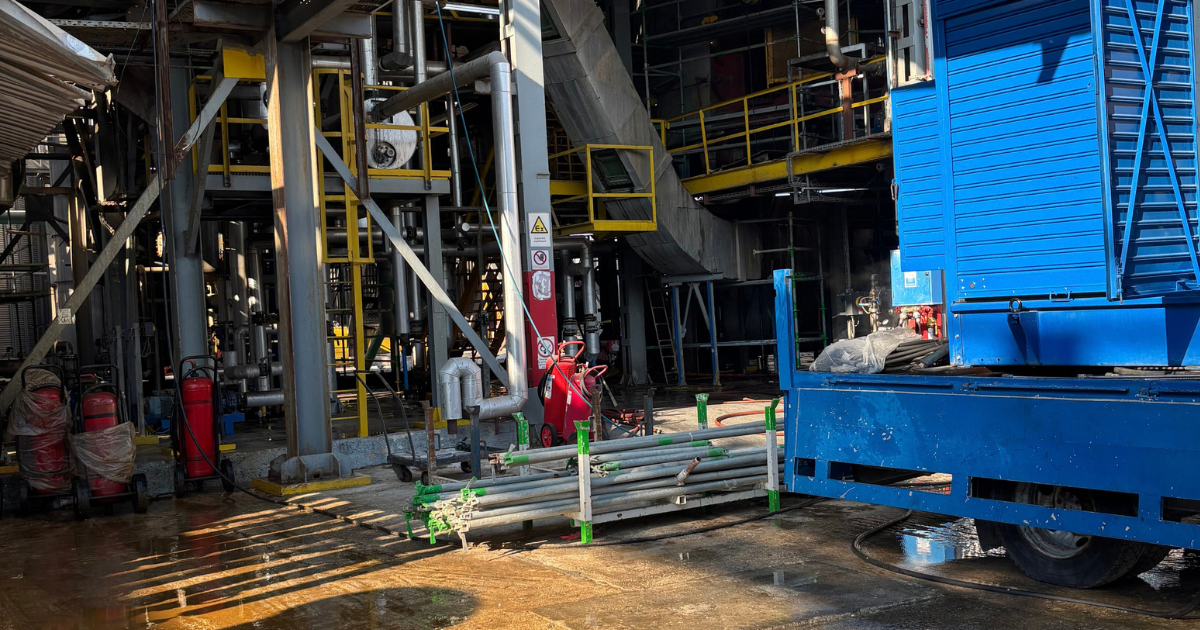
In a factory, there’s rarely just one type of contaminant. The same space can contain oils and lubricants on equipment, hardened deposits in tanks and piping, corrosion on metal structures, and sediment on floors and manholes. That’s why cleaning factories and industrial units can’t rely on a single method. It requires accurate diagnosis and adaptation to every point of the facility.
The Main Challenges
Every industrial unit has its own particularities, but certain challenges appear almost universally:
- Different types of contaminants and surfaces within the same space
- Difficult access among dense metal structures, piping, and elevated platforms
- Work carried out near sensitive equipment or in zones with heightened safety requirements
- Safe collection and management of residues after cleaning
Choosing the Method Based on the Contaminant
The effectiveness of industrial cleaning starts with correctly matching the method to the problem:
- High-pressure hydro blasting: for hardened deposits, scale, and rust on metal surfaces, tanks, and equipment
- Vacuum cleaning: for sludge, sediment, and liquid or solid residues
- Dry ice blasting: for electrical equipment and production lines where moisture is not permitted
- Water sandblasting: for surface preparation before painting
- Hydrocutting: when material needs to be cut without heat (cold cut)
Combining Methods Makes the Difference
In many jobs, the best result comes from combining methods. For example, hydro blasting dislodges deposits while vacuum equipment immediately collects the removed material. This way, the space is cleaned faster, personnel have less contact with residues, and the facility returns to operation sooner.
STEPE’s Experience
STEPE is one of the first companies to bring hydro blasting to Greece. It undertakes the cleaning of enclosed and open spaces in factories and industrial units: from equipment, floors, and tanks to towers and reactors. With hydro blasting machines reaching up to 3,000 bar, vacuum equipment, and trained personnel, it adapts the method to the needs of each project, aiming for a safe and complete result.