
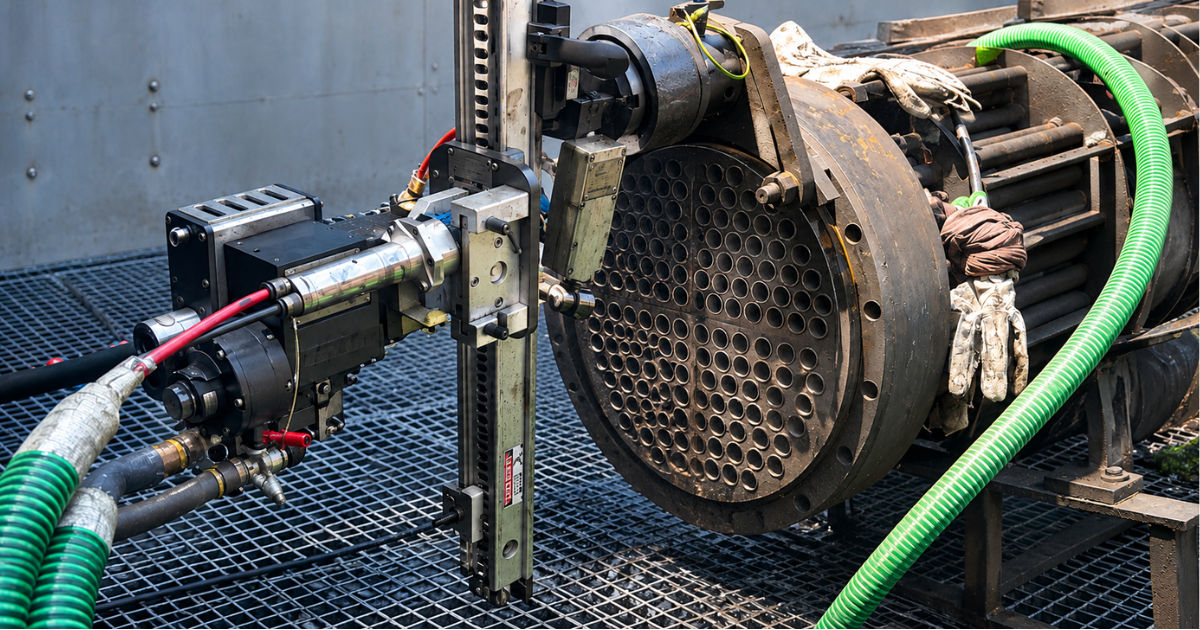
Cleaning a tube-bundle heat exchanger isn’t always just a matter of pressure. It’s a matter of precision: every tube must be fully cleaned, with none skipped, and without damaging the metal through an incorrect angle or excessive exposure time. The combination of ultra-high pressure with robotic equipment delivers exactly that level of control.
The problem of deposits in the tubes
Over time, the tubes of a heat exchanger accumulate residues, deposits, and corrosion products. This buildup reduces the flow cross-section and heat-transfer efficiency, resulting in increased energy consumption and, in advanced stages, the risk of blockage or equipment damage.
Why 3,000 bar
A pressure of 3,000 bar allows even hard, well-adhered deposits to be dislodged within the narrow cross-section of a tube, without the need for chemical additives or mechanical abrasion that could scratch the interior wall. The water jet works in a purely mechanical way, removing the material without altering the geometry or surface of the tube.
The role of the robotic equipment
The robotic equipment carries the high-pressure nozzle on a dedicated guide rail, which is positioned in front of the tube bundle and allows precise, guided entry into each tube individually. This ensures:
Systematic coverage of all tubes, with none skipped
Consistent depth and entry angle on every pass
Reduced need for manual intervention near the bundle during cleaning
Safety and precision in practice
Combining robotic equipment with ultra-high pressure reduces execution time and risk to personnel, as the need for direct contact with the bundle during cleaning is minimized. At the same time, the stability of the guide rail ensures a uniform result on every tube, something difficult to achieve with purely manual application.
STEPE’s experience
STEPE applies high-pressure cleaning with robotic equipment on heat exchangers in industrial facilities, combining ultra-high-pressure hydro blasting with precise, guided equipment. The result is a heat exchanger restored to peak thermal efficiency, with reduced downtime and lower risk for the crew.